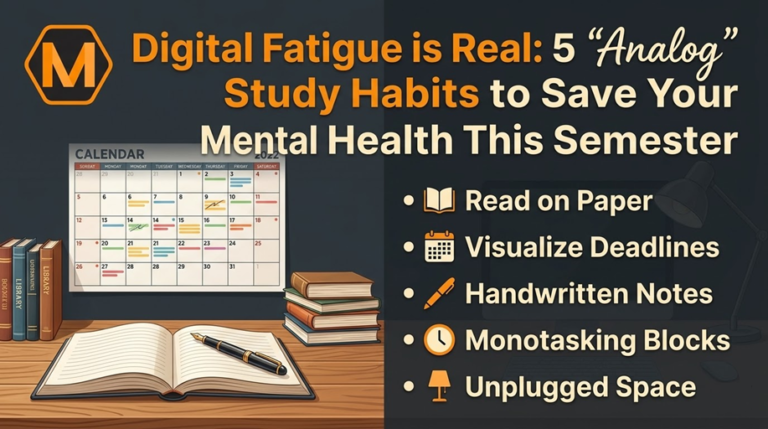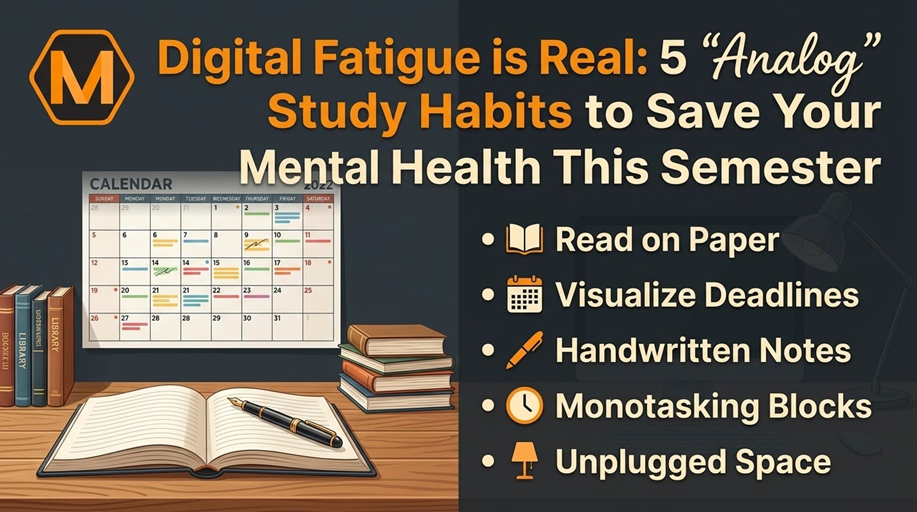
The modern university experience in 2026 is lived almost entirely behind a glowing glass pane. From the moment you wake up to the blue light of a smartphone alarm to the late-night flicker of a laptop screen while finishing a research paper, the digital world is inescapable. While technology has made information more accessible than ever, it has introduced a silent thief of academic success: digital fatigue. This isn’t just “being tired of Zoom”; it is a physiological state where your brain becomes overwhelmed by the constant flickering of pixels, the relentless ping of notifications, and the flat, non-tactile nature of digital reading. When your brain is constantly “on,” it never has the chance to engage in the deep, quiet processing required for true learning.
To combat this, many students are returning to the basics. By integrating offline strategies into your routine, you can protect your focus and your peace of mind. For those struggling to manage high-volume workloads, seeking professional guidance for complex projects or assignment help from experts at myassignmenthelp can provide the breathing room needed to step away from the screen and reset your mental health. Balancing expert support with hands-on, analog study techniques allows you to engage with your coursework on a deeper, more human level without the constant pressure of digital burnout.
The Science of the “Digital Brain” vs. the “Analog Brain”
Before diving into the habits, it is essential to understand why our brains struggle with 24/7 digital consumption. Human evolution did not prepare us for the rapid-fire delivery of information found on the internet. When we read on a screen, our brain enters “scanning mode.” We look for keywords and headers, skipping the connective tissue of an argument. This leads to fragmented thinking.
In contrast, analog interaction—touching paper, smelling ink, moving a physical pen—engages multiple senses. This “multisensory encoding” creates stronger neural pathways. When you physically move your hand to write, you are telling your brain that this specific piece of information is worth keeping.
Comparison of Information Processing
| Feature | Digital Processing | Analog Processing |
| Primary Action | Skimming & Scrolling | Deep Reading & Linear Flow |
| Neural Impact | High Cognitive Load (Distraction) | Low Cognitive Load (Focus) |
| Retention Rate | Lower (Short-term memory) | Higher (Long-term encoding) |
| Eye Strain | High (Blue light exposure) | None (Natural light reflection) |
| Tactile Feedback | Minimal (Glass/Plastic) | High (Paper texture/Pen weight) |
1. The Power of the “Paper-First” Brain Dump
When you start a new project, the temptation is to open a blank Google Doc and stare at the blinking cursor. This is a recipe for “blank page syndrome” and rising cortisol levels. Instead, try the “Paper-First” method. Grab a physical notebook and a pen. Write down every single thought, fear, and requirement related to your task.
There is a unique neural connection between the hand and the brain known as haptic feedback. When you physically write, you activate the Reticular Activating System (RAS) in your brain, which acts as a filter for your consciousness. A digital document feels temporary; a physical page feels like a commitment. Use this analog space to sketch out mind maps, connect ideas with arrows, and physically cross off completed thoughts. This tactile experience grounds you in the present moment and significantly reduces the “background noise” of digital distractions.
2. Print Your “Heavy” Readings for Active Engagement
Reading 50 pages of a dense academic PDF on a laptop is fundamentally different from reading it on paper. Research shows that digital readers suffer from “spatial instability”—they don’t remember where on a page a certain fact was located because the text is constantly moving as they scroll.
By printing out your most important research papers, you change your relationship with the text. You can underline, circle, and write “Check this!” in the margins. This is called active reading. Physical pages allow your brain to build a “spatial map” of the information. You might remember that a specific fact was “at the bottom of the left-hand page near the coffee stain,” which helps with memory recall during exams.
If you find yourself overwhelmed by complex data sets, particularly in technical subjects where precision is everything, getting Statistics Assignment Help can ensure your data interpretation is accurate while you focus on the broader conceptual understanding through your physical notes.
3. The “Analog Wall” Calendar for Visual Time Management
Digital calendars are excellent for reminders, but they are poor tools for “big picture” visualization. When your schedule is tucked away in an app, you have to click through different views to see how your month looks. This creates a sense of “time blindness” where deadlines seem further away than they actually are.
Buy a large physical wall calendar or use a whiteboard. Use different colored markers for different subjects. Seeing your entire semester mapped out on a wall in your room provides a constant, non-intrusive visual cue of your workload. It allows you to see the “crunch zones” where multiple deadlines overlap. Physically marking a big “X” through a day you’ve completed provides a dopamine hit that no digital notification can replicate. It turns your progress into a visible, physical reality.
4. The Leitner System: Tactile Flashcards Over Apps
In an age of Quizlet and Anki, the humble 3×5 index card might seem outdated. However, the act of physically creating a flashcard is the first step of memorization. When you type a card, it’s a passive mechanical act. When you write it, you are summarizing information in real-time to fit the small space.
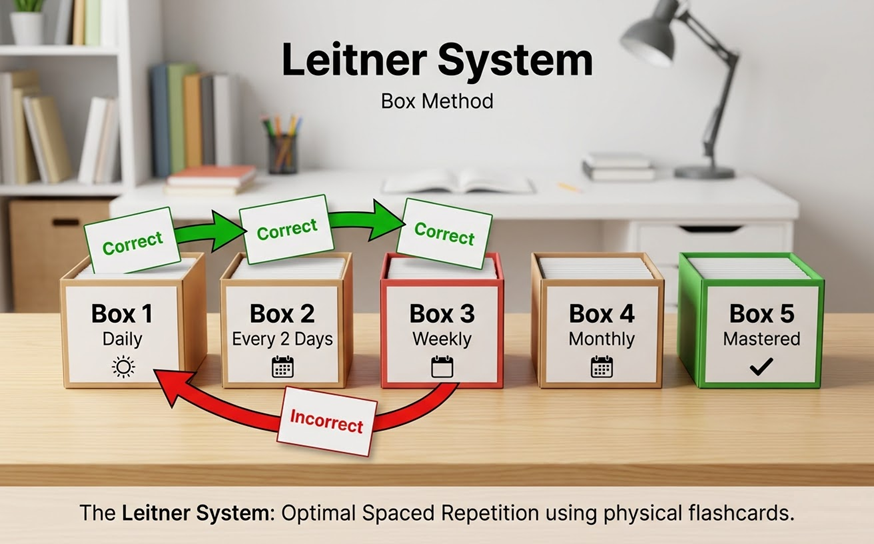
Try the Leitner System with physical cards and five small boxes.
- Box 1: New cards or cards you missed. Review daily.
- Box 2: Cards you got right once. Review every two days.
- Box 3: Review every four days.
- Box 5: Mastered cards. Review once a month.
Moving a card physically from one box to another provides a sense of physical progress. This method forces you into “monotasking”—the opposite of the multitasking environment of a web browser. Without the temptation to switch tabs to check social media, your concentration levels stay high.
5. Dedicated “Offline Zones” and Sensory Priming
One of the main causes of digital fatigue is that our study space is also our entertainment space. You use the same laptop for gaming or movies that you use for your dissertation. Your brain becomes confused about whether it should be “resting” or “working,” leading to a state of perpetual semi-distraction.
Create a physical boundary. Designate a specific spot—a corner of the library, a certain chair, or even just a specific desk lamp—that is an “Offline Zone.” In this zone, no phones or laptops are allowed. Use this space for your analog habits: reading physical books, writing drafts by hand, or reviewing your wall calendar. To enhance this, use sensory triggers like a specific scent (like peppermint for focus) or a certain type of instrumental music that you only use in your offline zone. This “primes” your brain for deep work and creates a mental sanctuary away from the digital chaos.
Why These Habits Will Save Your Semester
The goal of “analog” studying isn’t to abandon technology—that would be impossible in 2026. The goal is to use technology as a tool rather than a crutch. Digital fatigue happens when the tool begins to use us, pulling our attention in a thousand directions at once.
By reclaiming even 30% of your study time for physical, tactile methods, you are giving your nervous system a chance to regulate. You will find that your sleep improves because you aren’t staring at blue light until midnight. Your focus will sharpen because you’ve trained your brain to work without the constant “ping” of the internet. Most importantly, your academic work will reflect a deeper level of thought.
Real learning requires slow, deliberate processing. Whether it’s the scratch of a pen on paper or the smell of a physical library book, these sensory experiences anchor your education in the real world. This semester, don’t just survive the digital grind—step outside of it. Your mental health, and your GPA, will thank you for it.
Final Checklist for an Analog Reset
- [ ] Morning: Use a physical planner to write down the top 3 goals for the day.
- [ ] Study Session: Turn off the phone and place it in another room.
- [ ] Research: Print the core 5 pages of your most difficult reading.
- [ ] Review: Spend 15 minutes at the end of the day updating your wall calendar.
- [ ] Evening: Read a physical book for 20 minutes before bed to avoid screen glare.
Frequently Asked Questions
How does digital fatigue specifically impact academic performance?
Digital fatigue causes “flicker vertigo” and cognitive overload, which shortens your attention span. When the brain is overstimulated by blue light and constant notifications, it struggles to move information from short-term to long-term memory, making it harder to recall complex concepts during exams.
Why is handwriting considered more effective than typing notes?
Handwriting requires a complex cognitive process called “desirable difficulty.” Because you cannot write as fast as someone speaks, your brain is forced to summarize and process the information in real-time. This physical act creates a stronger neural trace than the repetitive mechanical motion of typing.
What is the best way to start an “analog” transition?
Start with the “Paper-First” rule for new projects. Spend the first 20 minutes of any research or essay task away from your computer with just a notebook. This prevents the immediate distraction of the internet and allows you to establish a clear logical framework before you begin the digital drafting process.
Can analog habits really improve sleep quality for students?
Yes. Shifting to physical books and paper planners in the evening reduces exposure to blue light, which suppresses melatonin production. By replacing screen time with tactile study methods in the hour before bed, you allow your nervous system to downshift, leading to deeper restorative sleep.
About The Author
Thomas Taylor is a dedicated education researcher and academic strategist who focuses on the intersection of student wellness and peak performance. With a background in organizational psychology, Thomas specializes in developing sustainable study frameworks that help university students navigate the complexities of modern campus life. Representing myassignmenthelp, Thomas is committed to providing students with the practical tools and authoritative insights needed to achieve long-term academic success while maintaining a healthy mental balance.
About the Author